Showing posts with label Overwintering. Show all posts

Tuesday, September 13, 2016

Feeding dry sugar:

I ONLY recommend feeding dry sugar if feeding is necessary to accomplish YOUR goal of keeping a hive from starving. Let me be very clear that the proper way to keep bees in the TF concept is to let an established hive die if it refuses to gather enough honey to survive the winter. They are not pets. They are not rabbits. You don't need to dump food in their home. Their very purpose is to go out, get food, and bring it back to you.
That being said, sometimes when you're just starting out, or starting with packages (not recommended) or the first winter with a swarm or a split, feeding might be necessary to accomplish YOUR goal of the hive not dying. I find syrups to be very risky because they cause robbing and bees will refuse to take them in the winter. Pollen substitute should never be fed for the simple reason that the best way to stimulate hive to make brood in the spring is to have bees well adapted to your area. Feeding dry sugar has the benefits of: minimal amount of work, not stimulative, will not cause robbing, cannot be fed except in winter when needed, and will not end up in next year's honey crop.
How to do it, Follow these steps:
1. Open the top of the hive.
2. Find the cluster.
3. Remove empty boxes above the cluster. (If you have boxes of honey above the cluster, then you don't need to feed. Only do this if there is not enough honey left to survive the winter).
4. Place a paper towel on the top bars right above or on top of the cluster. Those shorter sheets work well because three of them are about the size of the box.
5. Pile sugar on the paper towel. If bees are flying, you may want to moisten it. I recommend not doing this until well into winter so bees aren't flying.
6. Place an empty box on the top of the hive around the sugar. The shorter the box the better. My favorite is the bottom three inches of a box sawed off a deep box to make a medium. But a medium or shallow or even deep will work.
7. Put the lid on.
8. As needed, open the top, lay down another paper towel, and pile more sugar on. The bees will only use what they need.
9. At the end of winter, remove chunks of sugar and store for reuse next year.
That's all there is to it. But remember, if you have a sufficient number of hives to absorb losses, it would be better to let poor performers pass on and replace them next year. Better yet, go into winter with more hives than you want or need so your losses will actually help your accomplish having the number of hives you want rather than work against it.

Wednesday, February 5, 2014

Winter of 2013-4 Will be One for the Record Books


This is what I've been going through lately.  In the picture above, you can see the eight remaining hives in my home hard.  The double stack on the middle left was my oldest hive, brought with me from Oregon, lasted for nearly 11 years.  After doing a post-mortem, I left the honey to be robbed out by the other bees.  The back left hive is gone also.  The two tan cube hives are doing great.

There has been more snow, more snow days, more days under 20 degrees, more days under 10 degrees, and more days under 0 degrees, than any winter since I have been living here.  I've lost six of 25 hives so far, and have gone days without stepping outside in several stretches.

The chickens refuse to go outside and we're down to two eggs a day.

Tuesday, September 17, 2013

Paring Down for Winter, September Snapshot


Last Saturday, I undertook to combine some hives I had left over from summer nuc production.  Several five frame nucs survived the summer, however, only one was packed out with honey and a little brood like I’d expect a good nuc to be, so I saved that one and mooshed the rest.  That leaves me working with a total of 27 colonies.  I’d be comfortable losing around seven this winter, however, if the trend keeps up, the chances are pretty slim.

What this did was allow me to get rid of less desirable stock (probably lowering my winter loss rate) and enlarge hives that I want to keep but that are unable to build up sufficiently during our long summer dearth.  In doing this, I’m accelerating natural attrition and accelerating my selective process to produce better bees for human uses.

This is also one of the benefits of having a larger number of hives.  You can operate more like a population rather than an individual.  There are many more possibilities to achieve success and many more things you can do to affect that success.

Furthermore, it goes counter to the idea that every hive must survive.  That’s not how it works in nature, why should we try to pull it off in agriculture?

I am also finally coming into full utilization.  Right now, I only have two empty deeps that are not being used.  I think with the exception of a couple new medium hives that all hives are of the size of three deeps or bigger.  The only hives that will be fed granulated sugar only in an emergency would be the medium ones, they are new and I want the medium hives to make it because I’m making a partial switch to mediums.  Nobody else will be fed under any circumstances.

There’s my September snapshot.  During a time when many beekeepers are treating or thinking of treating, this is the sort of thing a treatment-free beekeeper is thinking of.

Thursday, February 28, 2013

Winter Prep - Bee Informed National Survey

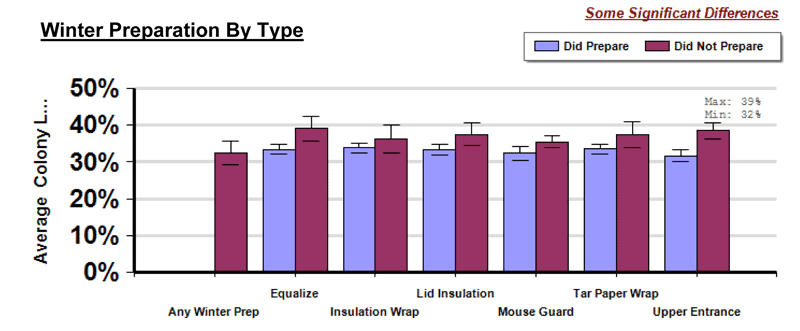
I like to participate in the Bee Informed national survey (beeinformed.org).  It allows me to really see what helps and what hurts in beekeeping management.  Here is an example:


This graph shows how many people used different types of winter preparations and what their loss rates were.  Now you may say "All of the methods helped."  But rather than looking at the bar graph which is the average, look at the range denoted by the little black whiskers.  That's the actual range of results.  Statistical analysis dictates which difference is significant.  But you can usually tell by which whiskers overlap.

For instance, the range of values for tar paper wrap overlap, demonstrating that the results were not significantly different while the use of an upper entrance were.  In fact, the greatest differences were found among the Upper Entrance group.

The other three that were effective were the 'Equalize,' 'Lid Insulation,' and 'Mouse Guard.'  The use of insulation or wrapping in tar paper are not shown to have different results than not using those methods.

I've never used equalizing, but I have Robin Hooded honey rarely.  But I'm happy to say the ones that I have been recommending for years are effective, upper entrances and insulated lids.  Mouse guards are pretty obvious, mice crawl in and eat honey and make nests.  Upper entrances allow better ventilation and the release of humid air which can cause condensation.  Insulated lids keep that condensation from collecting on the roof of the hive and dripping water on the cluster possibly killing it.

And as I've said for years, the bees don't heat the hive but rather heat the cluster.  Insulation is largely irrelevant.

Saturday, December 10, 2011

Building hives and More Inspections

I recently ordered an Oshlun stack dado blade.
What you're looking at is 124 (+/-) teeth of fury!  I'm going to use it to cut frame rests and rabbets for hive boxes as well as use it to cut dadoes for dividers in queen castles and nucs.  This is a pretty good quality dado blade and makes good quality stuff.  The cutters have 44 teeth and the chippers have six teeth each.  This makes for a very heavy set and the motor takes about five whole seconds to spin it up.  But it works fantastically, and I'm going to use it a lot as I'm building my new legion of medium boxes.

Here you can see my design for a 4x5 nuc, that's four five frame nucs in one box.  The last thing to add is the dividers.
I did a test run with the dado blade and made some ends for a 6 frame nuc.  All I need to do is cut the sides and make a bottom and lid and it will be ready to go.  Now that I think about it, it would make a perfect example for my first six frame medium nuc, possibly to overwinter.

Finally, here is evidence that given the opportunity, bees will size the entrance how they want it.
This is a hive in my outyard where the bees reduced the entrance even further than I had reduced it.  As you can see, they still didn't close it all the way off.  For context, this hive has a 1 1/2" round entrance near the bottom.

Another hive on this pallet seems to me to be burning too brightly.  By that I mean they are too big and using their stores too fast.  I hope they can slow it down and last the winter.  On the other hand, they are a bit mean, and with that in mind, I doubt I would breed from them.

Sunday, October 9, 2011

A Long Hard Summer and New Developments

Here's the most recent photo...

Business has been good.  I just sold my first two nucs last Saturday.  A gentleman drove up from Texas to purchase some late season nucs.

As you may be able to see in the picture, the grass is green again but it hasn't rained in two weeks.  Here's about the worst it got.


Here, I recorded temperatures of 114.8F and went from June until August without significant rainfall.

Fortunately, the temperatures are far more reasonable than they have often been throughout this warm season.  Since I last posted, I have set up my second outyard at a local organic free range chicken farm.


This pallet is on the bank of a small pond which is often dry.  I put extra bricks on top in case the local goats decide they want to play king of the hill.  With that many bricks, it's quite stable. 

In preparation for the move to mediums, I have been buying equipment that will fit.  As you should know by now, Mann Lake sells 4.95mm (PF-120) plastic frames which look something like this:


You can also see one of the medium division board feeders I bought and am currently using even though they're being used in deep hive body equipment.  In fact, two hives have two each due to the fact that I sold those two nucs.  And one could go even further if one wished.


Here are four feeders in a box just for fun.  That would total about five gallons of syrup if you really wanted to pound it down.  However, the drowning of bees could very well be quite significant.

I also purchased a little batch of Walter Kelley's foundationless medium frames.  As is my custom, I trimmed the end bars to 1 1/4" and as you can see, eleven fit in a box.  The box they are in is a former deep box which I trimmed down after the lower part rotted.  There are five more that I have marked for this same modification.  I did notice that the space between the topbars is pretty small, but I think it's still large enough for small cell bees to fit through, especially after the endbars have been propolized a bit.  In the future, I think I may trim the topbars a little bit so as to maintain a larger beespace.


Here you can see the beveled edge of the Kelley frame.  I was expecting more of a sharper edge, but we'll see how this works.  I have heard good things.
I am going to have to make a financial decision on which direction to go.  These frames are priced a little bit lower than Mann Lake's medium frames (which are standard types, not foundationless).  On the other hand, Mann Lake's frames are clearly superior in quality.  Mann Lake will be getting my business for the PF-120's which I plan to offer at a ratio of about 2:1 to foundationless frames.  Kelley also offers cheaper boxes as well, but I am not sure which direction to go on that either.  But that still may be in the future.  I still have to cycle through all my large cell equipment and systematically sell it as nucs.  10 frames down, 600 to go.

Going into fall, situations surely could be better.  I harvested no honey and many of the hives, in fact all the new ones, are either very low on stores or have none at all.  I am usually against feeding artificial feeds, but in this case, even if I had all the honey I ever produced, it might not be enough to get these hives through.  So I have to feed.  The heavy splitting I did earlier in the season allowed an increase in hives but a massive decrease in honey.  Such are Arkansas' seasons.  I am considering the fact that in the long run, it may be far more profitable to produce nucs rather than honey.  We shall see.  Until then, I need to get these bees through the winter.  Lately, every week I have been taking two and now three five gallon buckets filled with four gallons of 3:2 sugar syrup to the yards.  That's $15 a bucket.  No bueno.  Soon, I'll fill the feeders up with granulated sugar as the bees will stop taking syrup.  Then, it will be up to them.  Gotta keep a little survivorship in there.

Don't forget to check in at parkerfarms.biz from time to time as I continue to add content there as well.  Suggestions are always welcome.  Visit beesource.com where I am the moderator of the Treatment-Free Beekeeping section of the forum as well.