Showing posts with label Swarm. Show all posts

Friday, May 22, 2020

Micro Split Update:

Micro Split Update:
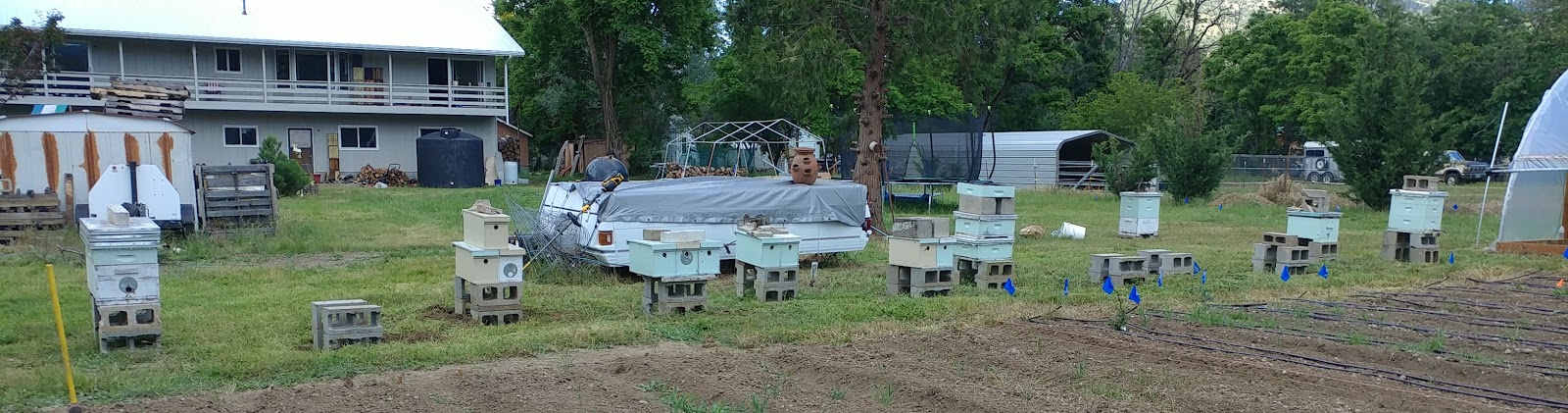
The experiment was to make micro walkaway splits, consisting of one frame open brood, one frame honey, one empty frame, and a shake or two of bees. Then move the nucs to a new location for a few days (or in this case until the queens made mating flights). Then move them back to the home yard for monitoring and working.
I have done the majority of moving the nucs from queen castles to 5-frame nucs now. They are in the stage of nuc rearing where the hive is laid full of brood and just before the brood begins to emerge and the worker population is at a low before they begin to be replaced.
Here are my results:
I split two hives into 15 nucs (plus the original hives). One nuc ended up with the queen from Hive B, which was my favored in terms of survival. I found the queen in Hive A, so assured she remained home.
Two or more of the emerging queens swarmed, forming a swarm with multiple queens. I hived the swarm, which is queenright, and caught one of the queens and placed her back in one of the nucs that appeared queenless, from the castle that issued the swarm, and it is now fine. One of the nucs was noted to be queenless yesterday and had developed laying workers, it was merged with a queenright nuc. Another nuc appeared to be queenless and was divided between two other nucs.
The medium nucs seem to have done well, filling up with brood very quickly, though perhaps suffering from low worker population.
The deep nucs largely ended up filled with brood and honey. That third frame of empty comb is important. And in fact, I would say these colonies perhaps need even less honey, I would venture half a frame or less. If you are keeping them in the same yard and they lose their field force back to the home hive, it is not as big a deal because they will use more, but they need that flex space to grow into when the new queen begins laying. One deep nuc appears to be well behind the curve, having open brood, no capped brood, and low on workers.
Swarming seems to be an issue, though probably a limited issue. I'm not sure yet how to remedy this, it may just be part of the process, capture any swarms issued and retrieve as many virgin queens as you can to put back into the nucs or make new nucs. Perhaps reduce the number of extra bees placed in the nucs at creation. Perhaps eliminate excessive numbers of queen cells made. Only one queen castle seems to have done this, so it may not be a significant issue, the sample size is still small.
So, overall numbers, 15 nucs made, 14 queenright nucs remaining, from two mother hives, 9 from one, 6 from the other. Mother Hive B also appears to be queenright having requeened itself successfully, so I'm counting that.
It's really not necessary to find the queen as long as you check the nucs soon after and see where the queen ended up, just make sure the mother hive retains one frame containing open brood. Interestingly, the queen did not build up enough to swarm even though she filled a three frame medium nuc to the gills. I found her before she had a chance.
This method is extremely similar to my queenright queen rearing method with queen castles as mating nucs, except eliminating the grafting and starter/finisher aspect of it. That makes it easier and more accessible to the new beekeeper.
I think I'm going to amend my recommendations for new beekeepers to start by building 5-10 swarm traps, convertible to new hives, and building or buying at least one queen castle. Queen castles have been totally reinforced in my mind as extremely helpful for the treatment-free beekeeper seeking to expand quickly. At this point, with my 10 3x3 queen castles, I have raised hundreds of nucs. And since they only come out for a month or so each year, they will last a very long time, indefinitely.
It also gives you the opportunity to take queens to be mated in a certain location if that's what you want to do.
One adustment I'm thinking of making is to make new medium queen castles as double 4-5 frame nucs instead of 3x3. Three medium frames is just really small for a colony. Also, while I have a wealth of deep 5-frame nucs, I have no medium nucs at all, which may hinder the move from 3-frame nuc to 10 frame hive.

Saturday, December 3, 2011

Mating Nucs

Here's today's photo, taken just a few minutes ago.


 Today, I'm here to talk to you about mating nucs, specifically of the 'queen castle' variety.

A queen castle is a type of nuc which contains only two or three standard frames.  It's purpose is to provide the function of the mating nuc while eliminating the need for an extra type of frame.  Some nuc designs use half size frames or tiny little topbars.  The question is what to do with these things at the end of the year, or how to get the bees to build on them in the beginning.  With standard sized frames, queen castles eliminate this difficulty.

Its prime use as a mating nuc is generally set up like this.  Standard methods are used to rear queens to the ripe cell stage.  Then, a frame of brood and bees and a frame of stores are placed in the queen castle with the ripe cell.  Later, the nucs are checked to see how the queen is coming along and if she's laying eggs and ready to be sold.  She can be removed and replaced with another cell repeatedly throughout the productive season.  I've been told that the 4x2 versions offer limited space to squeeze the cell in.  But according to my measurements, the three frame version offers a full 5/8" of space with normal frames.  Using narrow endbar frames offers an extra 3/8" on top of that.

Another benefit is for swarm control.  For instance, you go out to do a standard springtime inspection one day and you find a hive that is near to swarming with queen cells on four separate frames.  This presents a fantastic opportunity to get some free bees.  Take the queen and a couple frames and start a nuc with her off to the side.  Then take three of the frames with adhering bees and place each of them in the queen castle in separate compartments.  Add a frame of honey and pollen and an empty frame of comb or foundation.  Close the thing up and wait a couple weeks and you have new nucs.  You have the original queen in her nuc, one queen in the original hive, and three queens in the queen castle.  You can then use these queens to requeen other hives or use the nucs to start new hives.  You can also cut cells out and profit even more by using the method above.

Typical queen castles available at beekeeping supply establishments are the deep 4x2 and the medium 3x3.  These two designs allow just about the same amount of comb space.  Below you can see the design I came up with which in all probability is identical to the one Brushy Mountain offers.  It features a standard sized box which can be used as such during the rest of the year, and three nucs divided by pieces of 1/4" luan plywood.
Here's the detail of the end piece.  The side pieces are simply cut with no special dadoes or rabbets.  The end piece is cut by two 1/4" dadoes and two 3/4" rabbets on the ends.  The frame rest is the standard 3/8" by 5/8" cutout.  All cuts are 3/8" deep from the broad side.


This is the design, but I'm going to be using it a little differently.  I designed it as a medium even though I have all deeps at this point.  But as you know, I'm making the switch to mediums.  I'll build these as deeps and then at some point, I'll begin cutting them down to medium size.  It's a simple three inch difference.  The other part is that I'll make them about 1/4" taller than standard and attach the bottom board semi-permanently in the same way my 10 frame nucs are.

One thing I saw on the Bushkill Farms version was a big circular screened over vent at the upper side of the nuc to draw robbers while the actual entrance is small and located away in the bottom corner.

I'll be building these over Christmas Break, and using them next year to efficiently boost my populations.

Saturday, November 5, 2011

Skep Beekeeping in the Heathland, Lower Saxony

Any beekeeper simply must watch these videos.  They present a fantastic view of how beekeeping was done in skeps.  Surely it did not start out this well managed, like today's beekeeping, this video demonstrates the result of centuries of beekeeping and management based on tradition and innovation.


See for yourself how this type of beekeeping shaped our current understanding of beekeeping.  See how things are done more or less the same, and completely different.  Notice how many more products of the hive this operation produces than just honey.

It thought it was interesting that they use wax essentially as a savings account as it's really the only product that can be stored indefinitely without diminishing in quality.

Saturday, May 28, 2011

Old Queen

Click on picture to enlarge.

Just caught this swarm a few days ago.  The queen's wings are quite tattered.  How old do you think she could be?  With wings like that, surely she has swarmed before.  The record is said to be nine years, but that was a queen with clipped wings.

Most of the swarms I catch around here seem to be very very small, likely less than a pound in most cases.  It leads me to hypothesize that there is a couple of small feral hives in small tree hollows in the area.  They are so small that an overflowing hive still produces a swarm that is this small.  It also leads me to hypothesize that the swarms I am catching are not being produced by my hives as my smallest hive being composed of a single deep would produce a swarm still much larger than this.  These last two swarms only covered approximately a single deep frame.

As you can see, this hive is composed of workers of a light complexion with well defined dark bands on their abdomens.  The other swarm is composed of workers with about 30% being dark complected like carniolans.  This is interesting to me because I'm still on the hunt for black queens.  None of my nine queens are black as of the current time.

Not all swarms draw small cell foundation well, this one is doing better than most which leads me to believe at least second generation away from a kept hive. 

Unfortunately for this queen, her days are surely numbered.  A supercedure cell already prepares her replacement.