Showing posts with label Queen Castle. Show all posts

Friday, May 22, 2020

Micro Split Update:

Micro Split Update:
The experiment was to make micro walkaway splits, consisting of one frame open brood, one frame honey, one empty frame, and a shake or two of bees. Then move the nucs to a new location for a few days (or in this case until the queens made mating flights). Then move them back to the home yard for monitoring and working.
I have done the majority of moving the nucs from queen castles to 5-frame nucs now. They are in the stage of nuc rearing where the hive is laid full of brood and just before the brood begins to emerge and the worker population is at a low before they begin to be replaced.
Here are my results:
I split two hives into 15 nucs (plus the original hives). One nuc ended up with the queen from Hive B, which was my favored in terms of survival. I found the queen in Hive A, so assured she remained home.
Two or more of the emerging queens swarmed, forming a swarm with multiple queens. I hived the swarm, which is queenright, and caught one of the queens and placed her back in one of the nucs that appeared queenless, from the castle that issued the swarm, and it is now fine. One of the nucs was noted to be queenless yesterday and had developed laying workers, it was merged with a queenright nuc. Another nuc appeared to be queenless and was divided between two other nucs.
The medium nucs seem to have done well, filling up with brood very quickly, though perhaps suffering from low worker population.
The deep nucs largely ended up filled with brood and honey. That third frame of empty comb is important. And in fact, I would say these colonies perhaps need even less honey, I would venture half a frame or less. If you are keeping them in the same yard and they lose their field force back to the home hive, it is not as big a deal because they will use more, but they need that flex space to grow into when the new queen begins laying. One deep nuc appears to be well behind the curve, having open brood, no capped brood, and low on workers.
Swarming seems to be an issue, though probably a limited issue. I'm not sure yet how to remedy this, it may just be part of the process, capture any swarms issued and retrieve as many virgin queens as you can to put back into the nucs or make new nucs. Perhaps reduce the number of extra bees placed in the nucs at creation. Perhaps eliminate excessive numbers of queen cells made. Only one queen castle seems to have done this, so it may not be a significant issue, the sample size is still small.
So, overall numbers, 15 nucs made, 14 queenright nucs remaining, from two mother hives, 9 from one, 6 from the other. Mother Hive B also appears to be queenright having requeened itself successfully, so I'm counting that.
It's really not necessary to find the queen as long as you check the nucs soon after and see where the queen ended up, just make sure the mother hive retains one frame containing open brood. Interestingly, the queen did not build up enough to swarm even though she filled a three frame medium nuc to the gills. I found her before she had a chance.
This method is extremely similar to my queenright queen rearing method with queen castles as mating nucs, except eliminating the grafting and starter/finisher aspect of it. That makes it easier and more accessible to the new beekeeper.
I think I'm going to amend my recommendations for new beekeepers to start by building 5-10 swarm traps, convertible to new hives, and building or buying at least one queen castle. Queen castles have been totally reinforced in my mind as extremely helpful for the treatment-free beekeeper seeking to expand quickly. At this point, with my 10 3x3 queen castles, I have raised hundreds of nucs. And since they only come out for a month or so each year, they will last a very long time, indefinitely.
It also gives you the opportunity to take queens to be mated in a certain location if that's what you want to do.
One adustment I'm thinking of making is to make new medium queen castles as double 4-5 frame nucs instead of 3x3. Three medium frames is just really small for a colony. Also, while I have a wealth of deep 5-frame nucs, I have no medium nucs at all, which may hinder the move from 3-frame nuc to 10 frame hive.

Wednesday, March 27, 2013

Expansion Model Beekeeping


Do you ever get that feeling when someone puts something you have been thinking about in to a nice neat concise terminology that makes sense and summarizes your thoughts into a cogent concept?

I do, all the time.  It’s okay though, I don’t have to put a name to everything I think about.  But I can innovate and modify it.

The same thing happened recently at NEOBA’s Big Bee Buzz.  I was enjoying a presentation by Sam Comfort, a beekeeper of some renown who keeps bees in a bit of an unconventional way.  His current push is for box hives.  He is also big into topbar hives and even calls himself a bartender. 

Hilarious, you had to be there. 

I have been suggesting for some time that to succeed in treatment-free beekeeping, one needs to understand how to increase, growing one’s own queens and though I don’t use the term “outbreed the mites,” it does work.  I have found that it takes several years of outbreeding the mites and then at some point, the bees quit dying in large part.  Don’t confuse outbreeding the mites with causing brood breaks, I don’t rely on brood breaks for mite control.

So my idea is to focus on perfecting rapid expansion methods rather than spending time studying about what treatments to use, how to use them, and burning money on them.   And I’m going to call it Expansion Model Beekeeping.  Sam thinks it’s a good idea too.  He said it first.  Full credit to that.

What are the tools?

A far better investment than any treatment is a queen castle.  I have been promoting queen castles since I found them.  They are hives where one essentially divides a full size box into two or three frame nucs and then uses those nucs, with full size normal frames, to raise queens, either as traditional mating nucs, or as a place where one can put a swarm or supersedure cell with its frame and bees to hatch out and mate and found a new hive.  Small hives like this are machines, excellent at rapid expansion, comb drawing, brooding, and growing.  They can quickly be moved into a larger nuc or used to requeen a lackluster hive whose main problem may be disease issues.

If caught in the right time, a hive preparing to swarm can yield as many as a dozen new queens and nucs, but only if you have the equipment to put them in.  If managed to produce queens, a hive can produce dozens at a time, every few weeks.  Queen castles can turn all these queens who successfully mate into new hives.  These new hives draw comb and expand at an amazing rate.  At the same time, you are placing firm selective pressure on these hives to deal with and survive mites and other maladies.  In just a couple generations, diseases are no longer a major problem in your day to day management of hives.  With more selection techniques applied to the resulting queens, you can do the same thing with gentleness and productivity.

But this isn’t a quick ‘take two and call me in the morning’ solution.  It’s not a treatment, something you can toss money at and expect miracle results.  Treatments don’t produce miracle results anyway, but that’s a topic for another day.  This is something that takes learning and as I’ve said often enough before, you gotta jump right in.  Timidity at the beginning often ends in failure.  We’re working with bees who’ve for the most part not been bred for survival, instead relying on treatments to keep them alive and focused almost solely on production.  Furthermore, mass numbers of bees, queens, and nucs, are shipped out of the south every year because people demand early queens and packages and nucs.  But these bees are not accustomed to your climate.  Their mothers just survived a winter that looks more like your Halloween than the proper winters you’re accustomed to.  And this is the case for just about everyone north of 35 degrees latitude which is a major portion of the population.

If you’re getting bees from the South, your bees are not accustomed to your conditions.  This leads to common problems like when bees starve to death inches from capped honey.  For some ridiculous reason, this common problem is pawned off on mites or some other disease.  I had it happen a fair number of times and always to bees originally raised in climates with milder winters like California or Georgia.  It’s an unacceptable condition and it can be avoided for the most part by maintaining bees well adapted to your conditions.

Catching local swarms is another excellent aspect of Expansion Model Beekeeping.  Sam Comfort mentions that he puts up 100 swarm traps every year.  Swarm traps are a good way to enhance your collection with new and varied genetics, whether they are from local feral swarms or from other local kept hives.  Concerned about watered down genetics?  Your winters and diseases and mites will take care of those issues for you.  Use selective pressure to your benefit.  Allow the natural selective pressure to weed out the weakest hives for you.  Remember, your focus is on out-breeding the problem and adapting to it, just like Nature does.  We have a strong and virulent organism in the honey bee.  It has an incredible ability to adapt and survive in all sorts of conditions and pressures.  But it needs some time and new generations

The idea behind this whole philosophy is operating, at least for now, like you want to be a commercial beekeeper in five years.  The focus is increase.  Pretty quickly as I’ve found out, the bees quit dying out so much.  Now I’m at the point where I have the number of hives I want to have.  I have the volume of equipment that I can sustain.  So what do I do with the extra bees?

The first thing you can do is continue to develop strong, gentle, and productive bees.  You can do that by continuing to breed or split from your best queens and requeening poor performers.  If you have extra at the end of the year and don’t want to overwinter a certain number, combining is easy by killing off the less favored queen and placing her hive on the better hive.  There are various ways to do that, newspaper combines and the like.  You can keep some hives as nucs and they can be used to draw comb without feeding, or keep queens in reserve.

Another thing you can do is use your bees to make a little more money or give gives or use them as trade.  You can do this by raising queens, selling nucs, or selling packages or shook swarms (packages with their original queen).  Maybe you don’t want to ship or sell out of town, but you can help your friends and neighbors get started.  Form small cooperatives where you can rely upon your neighbors to provide you a frame of brood to restart a hive with a missing queen, or market your honey together.

It would be fantastic if more beekeeping associations were able to provide the packages, queens, and nucs that their members need without needing to have them shipped in.  If a handful of members were able to provide even limited numbers, it would be enough to get their friends started or help associates sustain their hives and replace their dead outs.  The focus needs to be on local production and adaptation rather than buying bees seemingly ‘off the shelf.’

The ultimate goal is beekeepers whose bees don’t die in large numbers and who have a strong support group to help them grow and learn how to keep bees without resorting to medicating them or expending large amounts of energy trying to keep them alive.  They should stay alive on their own and leave you the beekeeper to do the things you started beekeeping to do.

Wednesday, April 25, 2012

New Queens, Hives All Over the Place

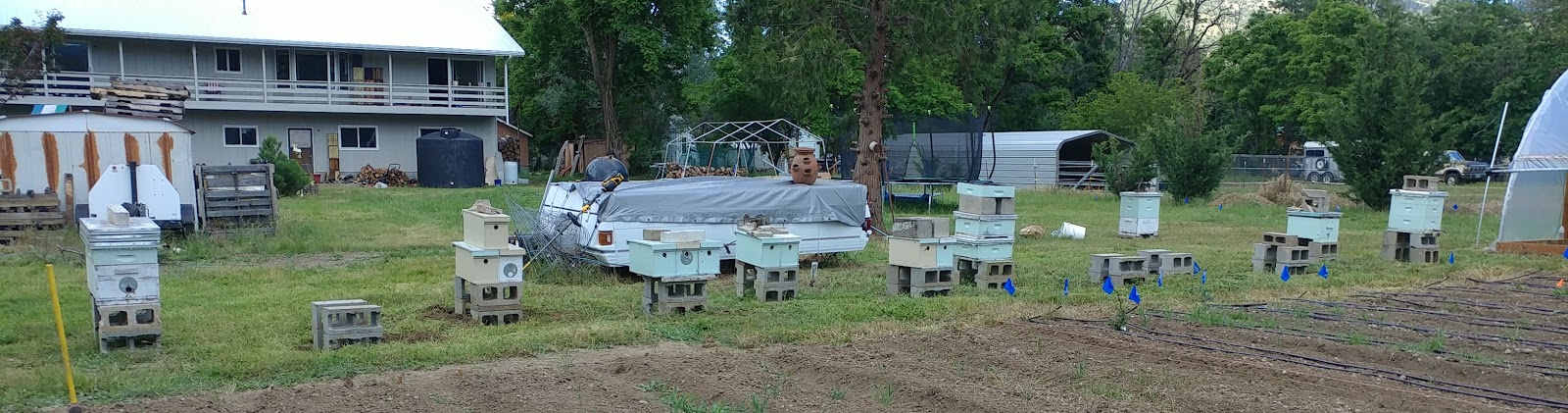
 Here's the latest picture of the home yard.

There's been a lot going on and not enough time to write about it and a deficit of pictures to explain.  

But here's one that should explain a little.


These are the queen cells taken from my queenless starter/finisher.  As you can see, 11 of 18 made the cut.  In the queenright starter/finisher, 17 of 18 made it through.  I've decided to use the queenright method from now on.  It's much easier, very simple, and you don't have any of the downsides related specifically to queenless methods.  This small sample size also shows how well it can work for a first timer compared to queenless, however, don't trust just two tests.

After the cells were matured, I got out on a Tuesday morning a few weeks ago and robbed seven hives of all but one frame of brood to have enough brood to make up the mating nucs.  The mating nucs are 3x3 queen castles that I designed and built myself.
In each, I placed an empty drawn comb, a comb of honey, and a frame of brood with adhering bees.

You can see in the picture at the top of the page most of them.  Three are in other places around the property.  After the queens hatched, I removed the queen cells and cell protectors.  The JZBZ cell protectors don't fit over the cell, but they still can protect and be used as a way to attach the cell to the comb.

After checking them a couple times, I can safely say that the vast majority have mated and returned healthy.  I have found one where the queen didn't return and one where the queen has not begun laying.  Out of 28 cells, those are pretty good numbers.  The nucs are all brooding and the first weekend in May, I will begin culling, combining, and figuring out where they will all be going.

My goal is to go into winter with at least 25 hives and the extras will be sold as nucs.  So, not too long and there will be nucs for sale.

Saturday, December 10, 2011

Building hives and More Inspections

I recently ordered an Oshlun stack dado blade.
What you're looking at is 124 (+/-) teeth of fury!  I'm going to use it to cut frame rests and rabbets for hive boxes as well as use it to cut dadoes for dividers in queen castles and nucs.  This is a pretty good quality dado blade and makes good quality stuff.  The cutters have 44 teeth and the chippers have six teeth each.  This makes for a very heavy set and the motor takes about five whole seconds to spin it up.  But it works fantastically, and I'm going to use it a lot as I'm building my new legion of medium boxes.

Here you can see my design for a 4x5 nuc, that's four five frame nucs in one box.  The last thing to add is the dividers.
I did a test run with the dado blade and made some ends for a 6 frame nuc.  All I need to do is cut the sides and make a bottom and lid and it will be ready to go.  Now that I think about it, it would make a perfect example for my first six frame medium nuc, possibly to overwinter.

Finally, here is evidence that given the opportunity, bees will size the entrance how they want it.
This is a hive in my outyard where the bees reduced the entrance even further than I had reduced it.  As you can see, they still didn't close it all the way off.  For context, this hive has a 1 1/2" round entrance near the bottom.

Another hive on this pallet seems to me to be burning too brightly.  By that I mean they are too big and using their stores too fast.  I hope they can slow it down and last the winter.  On the other hand, they are a bit mean, and with that in mind, I doubt I would breed from them.

Saturday, December 3, 2011

Mating Nucs

Here's today's photo, taken just a few minutes ago.


 Today, I'm here to talk to you about mating nucs, specifically of the 'queen castle' variety.

A queen castle is a type of nuc which contains only two or three standard frames.  It's purpose is to provide the function of the mating nuc while eliminating the need for an extra type of frame.  Some nuc designs use half size frames or tiny little topbars.  The question is what to do with these things at the end of the year, or how to get the bees to build on them in the beginning.  With standard sized frames, queen castles eliminate this difficulty.

Its prime use as a mating nuc is generally set up like this.  Standard methods are used to rear queens to the ripe cell stage.  Then, a frame of brood and bees and a frame of stores are placed in the queen castle with the ripe cell.  Later, the nucs are checked to see how the queen is coming along and if she's laying eggs and ready to be sold.  She can be removed and replaced with another cell repeatedly throughout the productive season.  I've been told that the 4x2 versions offer limited space to squeeze the cell in.  But according to my measurements, the three frame version offers a full 5/8" of space with normal frames.  Using narrow endbar frames offers an extra 3/8" on top of that.

Another benefit is for swarm control.  For instance, you go out to do a standard springtime inspection one day and you find a hive that is near to swarming with queen cells on four separate frames.  This presents a fantastic opportunity to get some free bees.  Take the queen and a couple frames and start a nuc with her off to the side.  Then take three of the frames with adhering bees and place each of them in the queen castle in separate compartments.  Add a frame of honey and pollen and an empty frame of comb or foundation.  Close the thing up and wait a couple weeks and you have new nucs.  You have the original queen in her nuc, one queen in the original hive, and three queens in the queen castle.  You can then use these queens to requeen other hives or use the nucs to start new hives.  You can also cut cells out and profit even more by using the method above.

Typical queen castles available at beekeeping supply establishments are the deep 4x2 and the medium 3x3.  These two designs allow just about the same amount of comb space.  Below you can see the design I came up with which in all probability is identical to the one Brushy Mountain offers.  It features a standard sized box which can be used as such during the rest of the year, and three nucs divided by pieces of 1/4" luan plywood.
Here's the detail of the end piece.  The side pieces are simply cut with no special dadoes or rabbets.  The end piece is cut by two 1/4" dadoes and two 3/4" rabbets on the ends.  The frame rest is the standard 3/8" by 5/8" cutout.  All cuts are 3/8" deep from the broad side.


This is the design, but I'm going to be using it a little differently.  I designed it as a medium even though I have all deeps at this point.  But as you know, I'm making the switch to mediums.  I'll build these as deeps and then at some point, I'll begin cutting them down to medium size.  It's a simple three inch difference.  The other part is that I'll make them about 1/4" taller than standard and attach the bottom board semi-permanently in the same way my 10 frame nucs are.

One thing I saw on the Bushkill Farms version was a big circular screened over vent at the upper side of the nuc to draw robbers while the actual entrance is small and located away in the bottom corner.

I'll be building these over Christmas Break, and using them next year to efficiently boost my populations.