Friday, March 22, 2013

Ed Levi, How I don't medicate my bees

Ed Levi is a retired Arkansas State Bee Inspector.  He's a yearly fixture at the Big Bee Buzz and he always has great talks with lots of good information and great slide shows. 

He started this evening's presentation by explaining how he doesn't treat his bees.  He just doesn't.  As a veteran beekeeper, he had a lot to say about the chemicals and their effects.  He is a user of the very soft and mechanical methods.  He takes a softer style IPM approach.He keeps track of his mite levels but he's not a hard Bond method beekeeeper.  The Bond style refers to the "live and let die" sort of philosophy that I subscribe to.Compared to my methods, he is much more active, giving the bees much more help.  He replaces his queens once a year.  His losses are quite good, this year less than 8%.


Let the Big Bee Buzz Begin!

There's Sam Comfort.

I walked in to my friend Neil's place, and there's Sam Comfort playing the piano!  Great start to the weekend, getting the chance to sit down for a couple hours and talk to one of the few treatment free beekeepers around, at least the more visible ones.  Michael Bush is here too.  I'll take a picture of him to prove it later.

Anyway, this thing is going to get started before long.  I'm going to try to blog as much as I can about it because we have three fantastic speakers and they have a lot of good information.  Stay tuned.


Sunday, March 17, 2013

So Much for My 100% Survival

I inspected my south yard yesterday and found a couple interesting things, one of which I have shown before.  It's a hive that created its own dam of propolis across the entrance area presumably to act as an entrance reducer.

Secondly, that hive died.

That makes it one hive dead for this winter, a percentage loss of 4.3%.

While opponents of treatment-free beekeeping continue to disagree, I'm considering this a wild success.  For three years now, my losses have been below, well below, or far below industry and national averages.  This is not a miracle, it's the result of nature handling disease and a decent beekeeper handling management.  This latest inspection demonstrates a greater number of active and productive hives

New Rule

If you wave your hand over an open hive and bees fly up to sting it, requeen.

Thursday, March 14, 2013

NEOBA Big Bee Buzz

The Big Bee Buzz has returned this year.  It's the Northeast Okalhoma Beekeepers Association's yearly get together where they invite well known speakers to present on beekeeping topics.
 This year, they feature Michael Bush, Ed Levi, and Sam Comfort.
And I'm going to be there.
And I'm going to blog it.
You should come too.  I'd post a link, but I'm practicing blogging on my phone and it's a lot of work to get a link.  But do a quick search and it's real easy to find.


Wednesday, March 6, 2013

Feeding Granulated Sugar

While I generally try to feed as little as possible.  When I do need to feed, I am lately trying to avoid syrup because of all the problems it causes.  So I feed granulated sugar.


This hive above as you can see never really made it up into the second box.  Being that this hive uses medium frames, a single box is not much.  Normally I wouldn't be so concerned about a small hive like this, but I want to raise medium nucs this year.  And while I don't need a medium hive to make queens for medium nucs, I do need brood on medium frames which means I need some medium hives to survive.  So I took out half a dozen frames or so and laid a paper towel across the space and put a couple pounds of sugar in there.  So you can see the result.


The time to feed is naturally when all other options are off the table.  It's early or mid winter and you can't feed syrup. Feeding is a last ditch effort to save a hive, not to prop it up, but to maintain its utility.  These hives that I fed will not be used for honey production or breeding.  For the most part, they will be split up to donate their brood to new hives which will be headed by queens bred from the best.  If they are lucky, the queen and some brood will be placed in a nuc to draw comb for the spring and then probably killed either by summer or by being combined with some stronger hive.  Much depends on each hive's spring performance.  A solid spring can make up a little ground from a weak fall and winter, especially for a yearling hive.

Friday, March 1, 2013

Nucs or Packages

When starting out in beekeeping, there are a couple of options, the most reliable of which are buying bees.  Sometimes if available, you can buy whole established hives, but they are expensive and rare.

The main options are nucs and packages.

A package is a bunch of bees in a screened box, usually 3 lbs.  A queen is included in her own cage and a can of syrup is usually included too.  These are made by dumping a bunch of random bees in a box and adding a queen.  The queen is not related directly to the bees, and in fact have come from different hives.  You know virtually nothing about either.  Your confidence in the sale is directly related to your confidence in the seller. 

A nuc (or nucleus hive) is a small hive, usually five frames.  If you have a quality seller, the queen will have been in the hive for a long enough period of time so that she has laid it full of brood and all the bees in the hive are her daughters and are representative of her genetics.

A package will lose a significant portion of its population before a single new bee hatches.  A nuc will have new bees hatching every day.  It is already a fully functioning hive.  It includes drawn comb.

Understand, I'm not hyping nucs because I sell them.  I do, but that kind of idea is backwards.  I sell nucs because I strongly believe they are the best option for starting new hives.  Well, the best option is splitting your own, but if you need to buy some, nucs are the best option.  And that's why I sell them.  If I thought packages were the best option, I would sell them. 

For a seller, packages are probably the best money making option.  They cost very little in resources, essentially just bees in a screened box.  And they tend to die about half the time in the hands of a new inexperienced beekeeper.  So not only do you sell a cheap product for a significant chunk of money, your customers keep coming back because the product they bought keeps breaking.

Well, there you have my view.  If you have any other questions, I am happy to answer them.

Thursday, February 28, 2013

Hive Weight Gain by Area, Know Your Flows

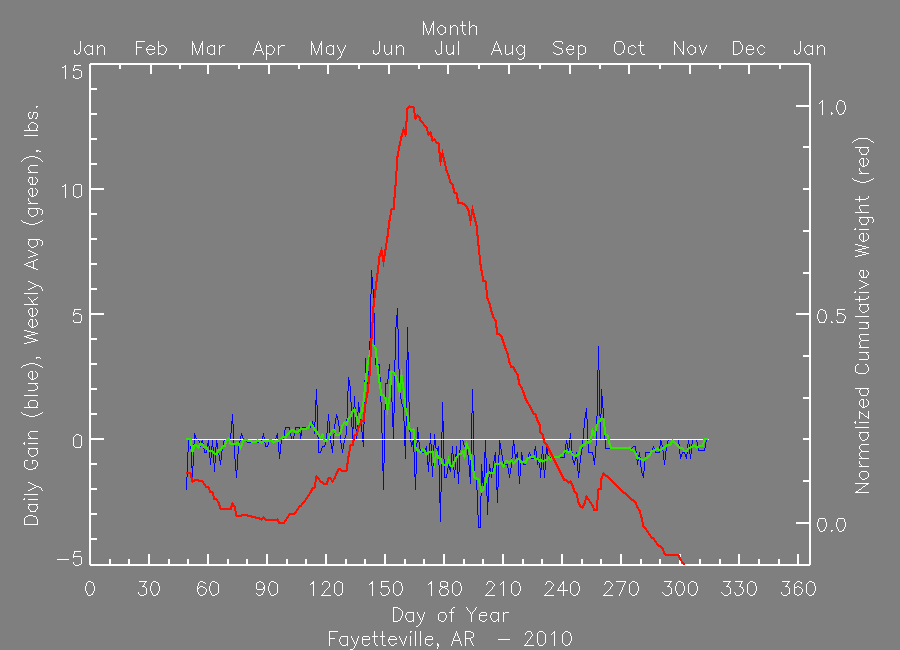
I discovered something interesting today.  NASA keeps track of hive weights around the country.  By knowing your flows, you can better manage your hives.

Here's a record from my local area:


I have historically harvested honey in June.  Seeing this graph tells me to make sure I leave enough honey for the bees to make it through the rest of the year because there's no more honey to be had.  Apparently the earlier flow is black locust in April and white Dutch clover becomes available in substantial measure in May.

As a side note, comparing this area to others, this is a really ugly area to keep bees.  No wonder there are no commercial beekeepers around here.

Check out your own area at:  http://honeybeenet.gsfc.nasa.gov/Sites/national_map.htm  Know your flows!

Winter Prep - Bee Informed National Survey

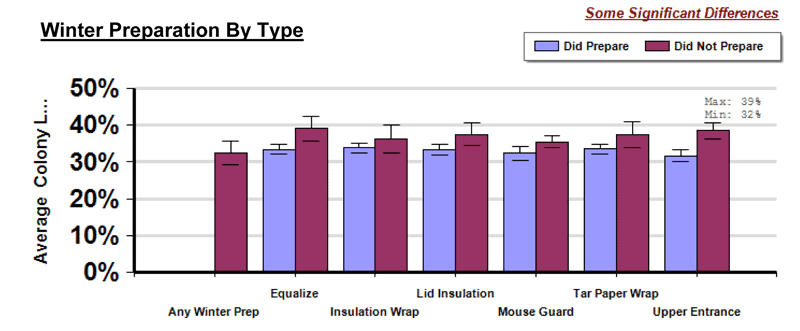
I like to participate in the Bee Informed national survey (beeinformed.org).  It allows me to really see what helps and what hurts in beekeeping management.  Here is an example:


This graph shows how many people used different types of winter preparations and what their loss rates were.  Now you may say "All of the methods helped."  But rather than looking at the bar graph which is the average, look at the range denoted by the little black whiskers.  That's the actual range of results.  Statistical analysis dictates which difference is significant.  But you can usually tell by which whiskers overlap.

For instance, the range of values for tar paper wrap overlap, demonstrating that the results were not significantly different while the use of an upper entrance were.  In fact, the greatest differences were found among the Upper Entrance group.

The other three that were effective were the 'Equalize,' 'Lid Insulation,' and 'Mouse Guard.'  The use of insulation or wrapping in tar paper are not shown to have different results than not using those methods.

I've never used equalizing, but I have Robin Hooded honey rarely.  But I'm happy to say the ones that I have been recommending for years are effective, upper entrances and insulated lids.  Mouse guards are pretty obvious, mice crawl in and eat honey and make nests.  Upper entrances allow better ventilation and the release of humid air which can cause condensation.  Insulated lids keep that condensation from collecting on the roof of the hive and dripping water on the cluster possibly killing it.

And as I've said for years, the bees don't heat the hive but rather heat the cluster.  Insulation is largely irrelevant.

Wednesday, February 27, 2013

A New Year

Sorry, no pic this time.  Weather is dreary and cold.  I don't like winter.  I'm very glad it's short here.

So, what's up this year?

Well, great news thus far.  As of yesterday when I stopped by one of my outyards, I have 100% survival of my 23 hives.  After last year's survival numbers (10/11) I am really stoked that my methods are finally being proved to be successful.  Just in time for my tenth anniversary of the day I drove to Orland California and bought my first 20 packages of bees.

This year, I plan on continuing to do what I began last year. 

I will be making more queens and nucs:  I have talked to several of last year's customers and as far as I know, they've had 100% survival of my stock.  I already have around ten reservations for queens and nucs.  After making 30 hives out of 7 last year, I should be able to make easily as many this year and make a fair amount of honey too.

I will continue my switch to medium hives:  I just finished (minus paint) eight new medium boxes.  It was great to fire up the old table saw again, though somehow I bent the fence.  And it is definitely an old table saw, it's older than me.  But it's a quality machine, all cast-iron and whatnot.  I need to make more of my ten frame nucs, but in medium sizes. I need to start moving mediums to the outyards and deeps back home.  Selling nucs will get rid of my deep frames and I will need to buy more medium ones.

I'm not going to attempt to catch swarms:  Last year I expended a lot of time, effort, and resources to put up swarm traps and got less than 10% return.  Now that I have as many hives as I want, I don't need them anyway.

I will continue to grow the hives that I have:  I have about a dozen deep boxes remaining, totally empty, ready for foundation.  And after my incredible increase from last year, I have a lot of hives which will need supering very soon.  Right now it is cold and the foundation is brittle so I'm holding off on that chore for the time being.

Settling into final numbers:  I originally wanted to run 20 hives, but with two locations with space for 8 each and the home yard with space for nine, 25 sounds about right.  I shall have to be more diligent this year in the fall with combining weak hives.  Not that they have trouble wintering, they seem to do fine, but I want to focus genetics on hives that are a little larger and build up faster in the spring.

And of course, I'll continue to be obnoxious on Beesource.com.  I have to keep needling the naysayers, explaining that after all these years, it still can be done and I am still doing it.

Saturday, June 23, 2012

Bubbly Nectar

Here is today's picture of the yard.


It's been hot lately.  My twin 5-frame nucs like to beard as a group.

Interesting thing I discovered today and have never seen before.  See if you can spot it.

If you said bubbly nectar, you win!
 I've never seen this before.  By the odor wafting from the hives, I'd say it's fermenting nectar.  So what's the cause?  If I were to make a guess, I'd think about the following things.  First, what flowers are blooming right now?  Are their nectars troublesome?  The main things I can see blooming at this time are chicory and clover, neither of which have I ever heard of this problem. 

Second, are the bees unable to cure the honey for some reason?  This is a possibility based on a few factors.  First, high humidity would make it difficult to cure honey.  Second, poor ventilation might cause the same problem.  All the hives I noticed this problem in today were ones that have a single 1.5" circular entrance.  The problem was more pronounced in 5-frame nucs, but also seen in single deep hives as well.  It was not seen in hives with more than one entrance or those with a wide bottom entrance.  In fact, in the picture above with the bearding bees, those are the hives where these frames were found.  They were not bearding this morning however.

I don't have a solid answer, but I think the second scenario is more likely, that poor ventilation is causing problems curing the honey, exacerbated by high humidity here in Arkansas.

Tuesday, June 19, 2012

Cube Hives in Final Configuration

Harvested honey this past week, 17 gallons.  Here's a pic of the yard.


You can see the tan colored cube hives in the front middle. The one on the right is fully decked out and the one next to it is just getting going.